
Reception Phonics Newsletters
| Name | Format | ||
|---|---|---|---|
| Files | |||
| Reception Summer 2 Phonics Newsletter.pdf | |||
| Phonics newsletter Reception Summer 1.pdf | |||
| Phonics newsletter Reception Spring 2.pdf | |||
| Phonics newsletter Reception Spring 1.pdf | |||
| Phonics newsletter Reception Autumn 2.pdf | |||
| Phonics newsletter Reception Aut 1.pdf | |||
Year 1 Phonics Newsletters
| Name | Format | ||
|---|---|---|---|
| Files | |||
| Phonics newsletter Year 1 Summer 2.docx | .docx | ||
| Phonics newsletter Year 1 Summer 1.pdf | |||
| Phonics newsletter Year 1 Spr 2.pdf | |||
| Phonics newsletter Year 1 Spr 1.pdf | |||
| Phonics newsletter Year 1 Autumn 2.pdf | |||
| Phonics newsletter Year 1 Autumn 1.pdf | |||
Nursery
In Nursery, our early stages of phonics teaching is focused on the development of children’s speaking and listening skills. Our children are explicitly taught to develop listening skills and to identify sounds around them in the environment. This is in preparation to begin developing oral blending and segmenting. This is achieved through our children experiencing environmental and instrumental sounds, rhythm and rhyme, alliteration and then oral blending. This knowledge and understanding of sounds is a crucial step for children in preparation for moving onto ELS Phonics.
Nursery Seven aspects:
• Environmental sounds
• Instrumental sounds
• Body percussion
• Rhythm and rhyme
• Alliteration
• Voice sounds
• Oral blending
Reception
Letters and their sounds are introduced to children one at a time, as soon as a group of letters are introduced, children are encouraged to use their knowledge of the sounds to blend and sound out words. By the end of Reception, children use their knowledge of phonics to read accurately with increasing speed and fluency.
Year One
In Year One, children are taught to read all common graphemes and are able to read unfamiliar words containing these graphemes. Phonics lessons have a strong focus on the teaching of common exception words. Children are encouraged to read these words on sight, daily, and they are a focus for weekly spellings. By the end of KS1, our children have gained phonic knowledge and language comprehension that is necessary for them to read with accuracy, understanding and fluency.
Impact
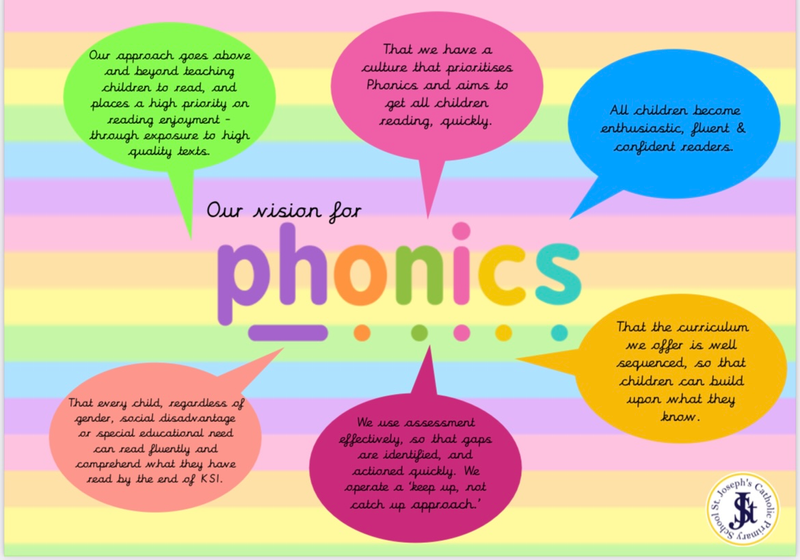
Through the delivery of daily phonics teaching all children are able to read and enjoy reading by the time they leave KS1. They are able to read fluently with expression and can confidently comprehend what they have read. It is evident through our use of assessment that our phonics teaching has a positive impact on the progress our children make in reading. Children use the taught letter rhymes across all subjects and, as a result of this, are able to form letters correctly when writing. They are able to write simple sentences by applying their phonics knowledge by the end of Year 1. Children show confidence in phonics sessions and in wider reading and can tackle new and ambitious vocabulary through applying their decoding skills. The teaching of phonics has a direct, positive impact on our children’s speech and language development, the correct modelling of pronunciation helps our children acquire new words and pronounce words they already know with greater clarity.
 Phonics
At St Joseph's Catholic Primary we follow Essential Letters and Sounds (ELS). ELS teaches children to read using a systematic synthetic phonics approach. It is designed to be used as part of an early learning environment that is rich in talk and story, where children experience the joy of books and language whilst rapidly acquiring the skills to become fluent independent readers and writers. ELS teaches children to:
• decode by identifying each sound within a word and blending them together to read fluently
• encode by segmenting each sound to write words accurately
Essential Letters and Sounds (ELS) teaches children to read using a systematic synthetic phonics approach. It is designed to be used as part of an early learning environment that is rich in talk and story, where children experience the joy of books and language whilst rapidly acquiring the skills to become fluent independent readers and writers. ELS teaches children to:
• decode by identifying each sound within a word and blending them together to read fluently
• encode by segmenting each sound to write words accurately.
If you would like to support your child in the correct pronunciation of these sounds, please click on this link.